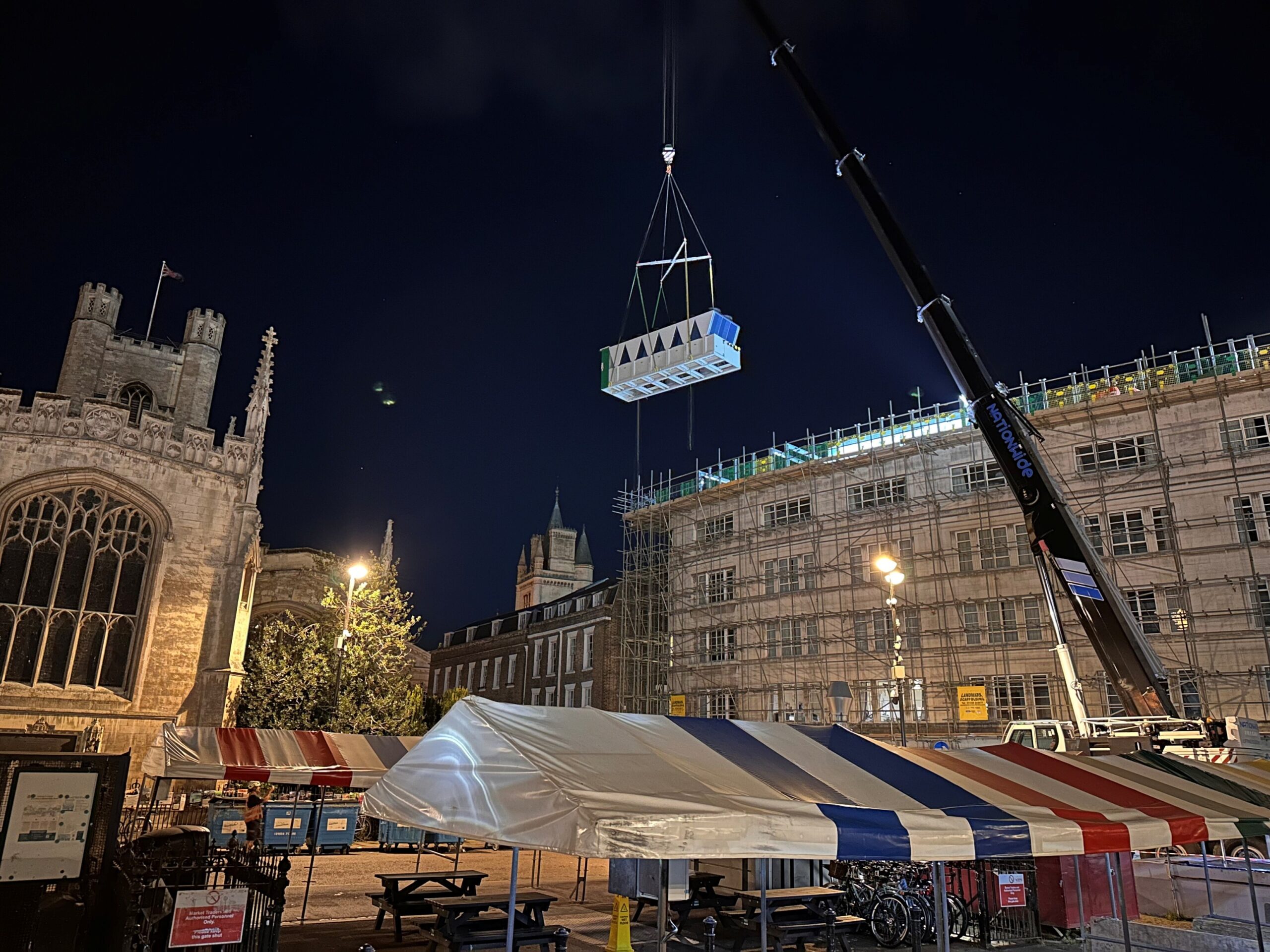
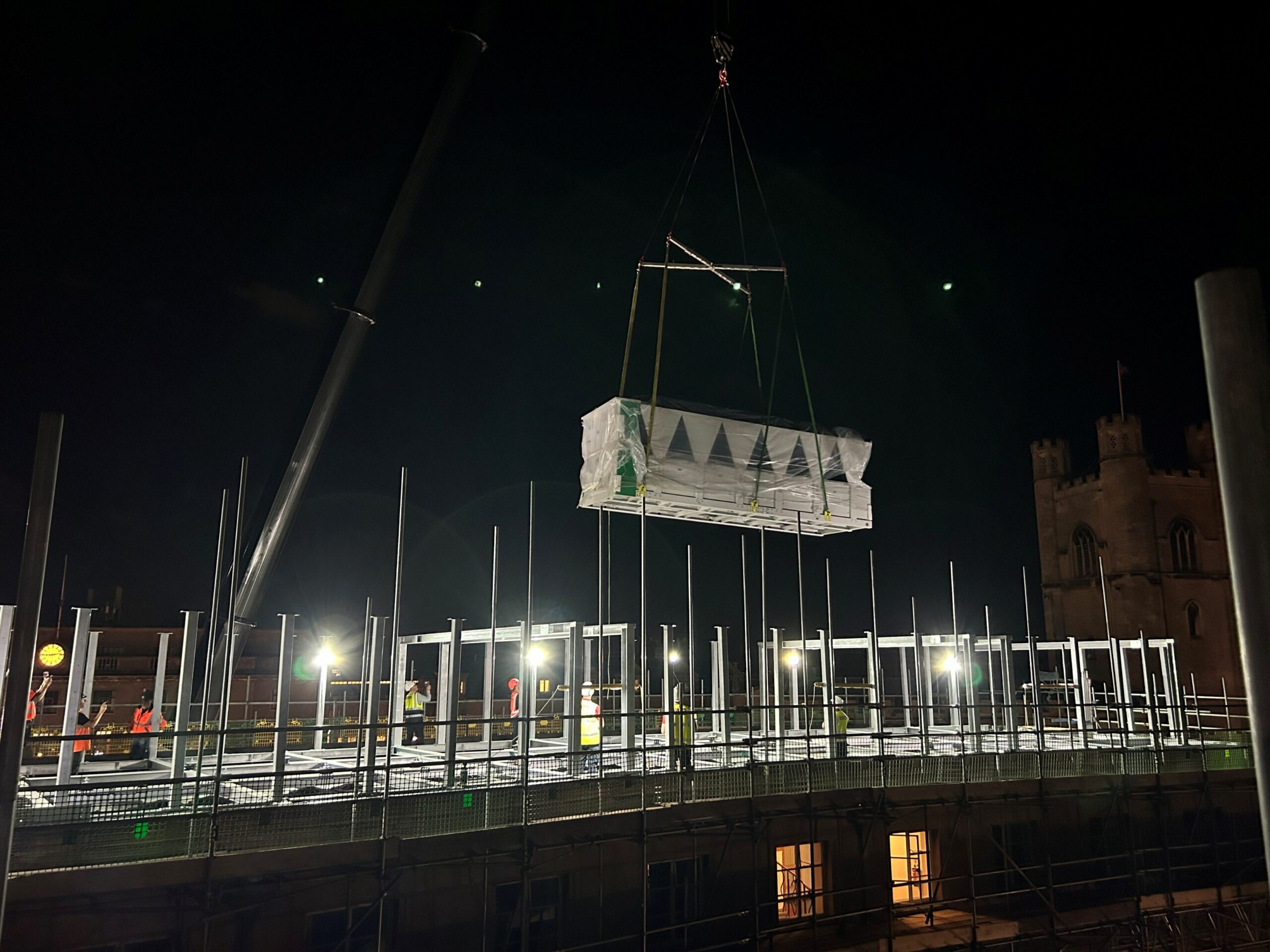
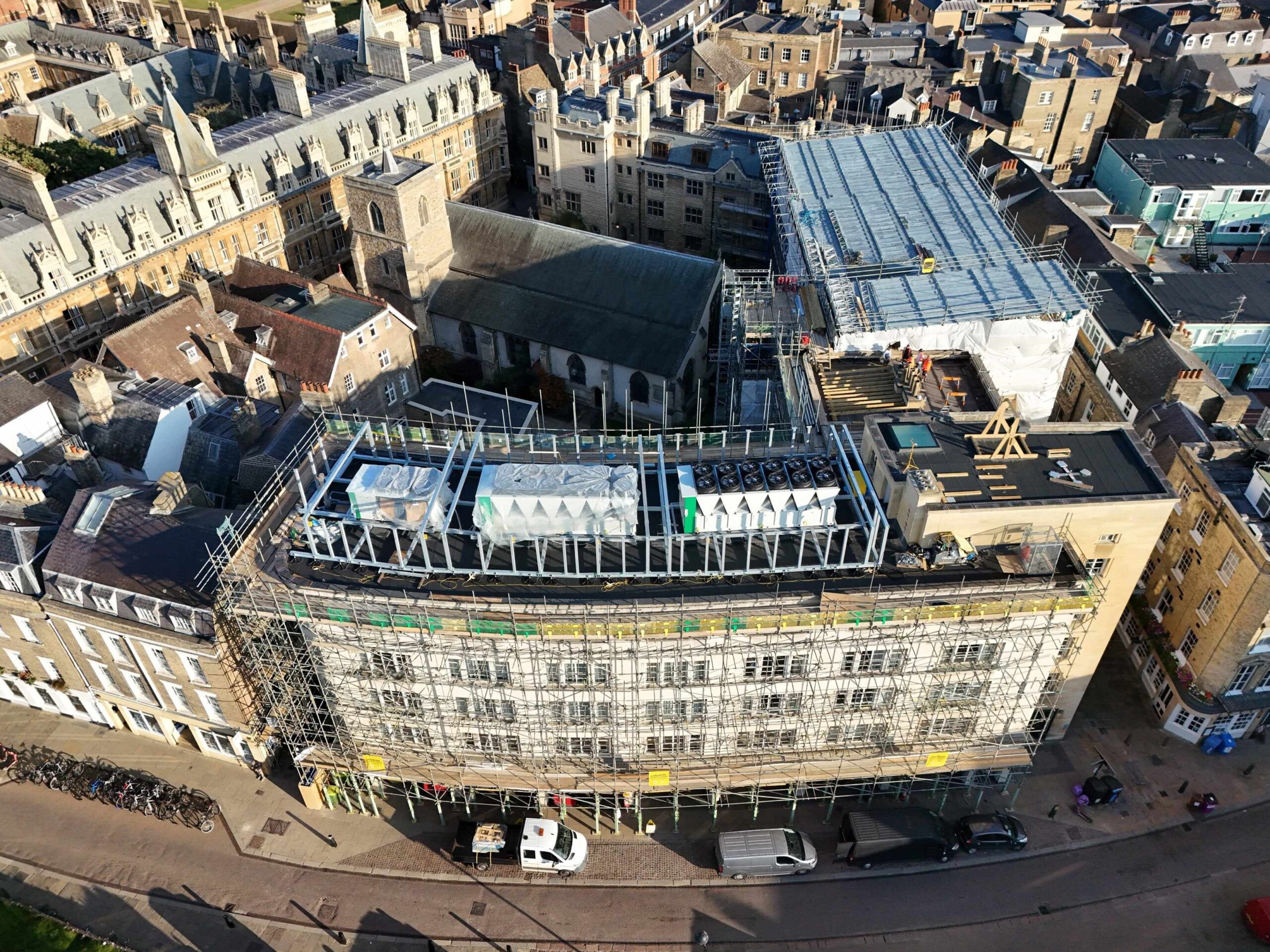
The scheme, implemented by the College’s Council and Decarbonisation Implementation Committee, has reduced gas consumption in the College’s Old Courts and showcases the College’s commitment to becoming a more sustainable site. The key to the decarbonisation process involved placing Air Source Heat Pumps (ASHPs) on top of the Murray Easton Building, which is situated on Cambridge’s busy Market Hill. The building has a flat roof so deemed the best location for the new ASHPs, after a complex architectural and structural design process which kept the heritage significance of the building whilst incorporating structural modifications to house the ASHPs.
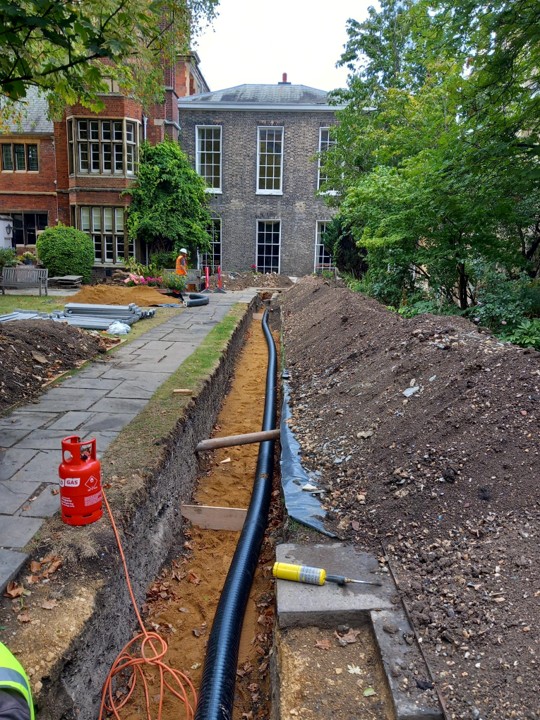
The new ASHPs generate power and heat the College’s Old Courts and St Michael’s Court buildings by way of a complex pipework infrastructure. Future works will expand renewable energy to other buildings and parts of the campus, allowing a move away from gas across the estate. Insulation will also be upgraded to reduce the demand for heat and minimise energy consumption.
During the project David Hills, Director of Architects rhp, said: “It is a privilege to work with a client so committed to carbon saving, alongside my colleagues at rhp, technical consultants Ridge, structural engineers AFP, Cocksedge’s construction team and many others. It is not often we get to combine our interests in state-of-the-art sustainable technology and Grade I and II Listed Buildings to such a positive purpose.”
Upon completion, the College’s Estates Manager said “I can personally vouch for the success of establishing and building a strong and trusted relationship with a single contractor. Doing so develops mutual confidence in the execution and delivery of significant projects and is often essential when compiling an effective Client Brief. Continuity of personnel also plays a crucial role. In our case, the consistent involvement of Mark Ashworth (Cost Manager), David Olen (Senior Site Manager), and Adrian Bishop (Contracts Manager) proved invaluable. Their familiarity with the site, together with their ability to facilitate practical access arrangements, contributed significantly to achieving positive project outcomes. Just as importantly, this continuity allowed robust and productive working relationships to develop and endure. Such consistency ensures continuity for all parties involved. Across our projects, it has enabled long-term decisions to be made rather than reactive choices based on singular events, ultimately saving the College both time and money.
Click here to see the ASHPs being lifted into place: Decarbonisation project milestone as Heat Pumps lifted onto roof | Gonville & Caius